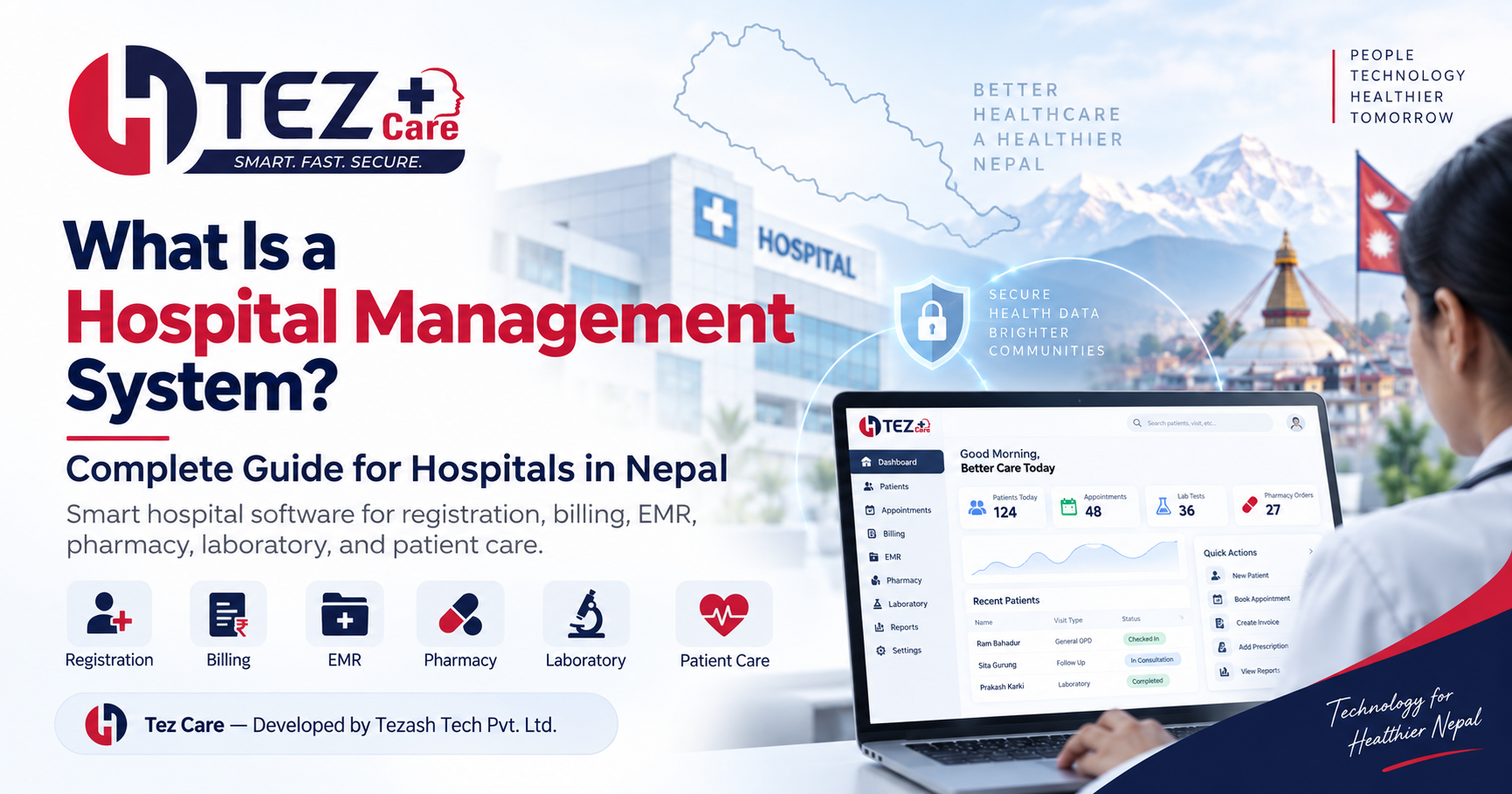
Managing a hospital involves much more than patient registration and billing. Every day, hospitals handle consultations, laboratory tests, pharmacy sales, admissions, insurance, payments, medical records, inventory, and reporting.
When these activities are managed through separate registers, spreadsheets, or disconnected software, errors and delays become more common.
A Hospital Management System (HMS) brings these operations together into one connected digital platform.
For hospitals in Nepal, a good HMS can improve patient service, reduce repetitive work, improve financial control, and make hospital operations easier to manage.
What Is a Hospital Management System?
A Hospital Management System is software used to manage the clinical, administrative, financial, and operational activities of a healthcare organization.
A typical patient journey may look like this:
Registration → Consultation → Laboratory/Radiology → Pharmacy → Billing → Payment → Follow-up
Instead of entering the same patient information in different places, an integrated HMS keeps the entire journey connected.
This helps doctors, reception staff, laboratory teams, pharmacists, billing teams, and management work with the same information.
Why Hospitals Need an HMS
As hospitals grow, manual processes become difficult to control.
Common problems include:
- Duplicate patient records
- Billing mistakes
- Missing patient history
- Pharmacy stock differences
- Delayed laboratory reports
- Difficult insurance management
- Repeated data entry
- Slow financial reconciliation
- Limited management reporting
A Hospital Management System helps reduce these problems by connecting hospital departments through one platform.
Main Modules of a Hospital Management System
A modern HMS can include:
- Patient Registration
- OPD Management
- IPD Management
- Emergency Management
- Electronic Medical Records (EMR)
- Laboratory Management
- Radiology
- Pharmacy Management
- Hospital Billing
- Insurance and Organization Billing
- Appointment Management
- Inventory and Store Management
- Financial Reports
- User Roles and Permissions
The exact modules depend on the size and needs of the healthcare organization.
Why Integration Matters
The real value of an HMS is not the number of features it has.
What matters most is whether the modules work together.
For example, when a doctor requests a laboratory test, the laboratory should receive the order, billing should know about the service, the result should be linked to the patient, and the doctor should be able to review it later.
That is what makes an integrated Hospital Management System valuable.
Benefits of Hospital Management Software
A good HMS can help hospitals achieve:
Faster patient service
Patient information can be found quickly, reducing waiting time.
Better coordination
Departments can work together through connected workflows.
Improved billing control
Services, payments, dues, discounts, and refunds can be tracked more accurately.
Better inventory management
Hospitals can monitor medicines, batches, expiry dates, purchases, and stock movement.
Improved patient history
Authorized doctors can access previous visits, diagnoses, investigations, and prescriptions.
Better reporting
Management can review collections, revenue, patient activity, and operational reports more easily.
Tez Health Care by Tezash Tech
Tez Health Care is a Hospital Management System developed by Tezash Tech Pvt. Ltd.
It is designed to help healthcare organizations connect their clinical, financial, and administrative workflows through one digital platform.
Depending on the hospital's requirements, Tez Health Care can support areas such as:
- Registration
- OPD
- IPD
- Emergency
- EMR
- Laboratory
- Radiology
- Pharmacy
- Billing
- Insurance
- Inventory
- Reporting
- User permissions
The goal is simple: make hospital operations more connected, organized, and efficient.
Smart. Fast. Secure.
Choosing the Right Hospital Management System in Nepal
Before choosing hospital software, healthcare organizations should consider:
- Ease of use
- Performance
- Integration
- Security
- Reporting
- Scalability
- Backup and recovery
- Training
- Technical support
Hospitals should not choose software only because it is cheaper or has a long feature list.
The best HMS is the one that fits the hospital's actual workflow.
The Future of Digital Healthcare in Nepal
Healthcare technology in Nepal is continuing to grow.
Modern hospital systems are moving toward:
- Artificial intelligence
- Workflow automation
- Patient portals
- Mobile applications
- Cloud platforms
- Digital payments
- Advanced reporting
- Device integrations
- Better interoperability
But technology should always solve a real healthcare problem.
Final Thoughts
A Hospital Management System can become the digital backbone of a healthcare organization.
It connects patients, doctors, laboratories, pharmacies, billing teams, and management through one system.
For hospitals in Nepal, moving toward connected digital healthcare can improve efficiency, reduce manual work, improve visibility, and create a better patient experience.
Tez Health Care, developed by Tezash Tech Pvt. Ltd., is built to support this journey with smarter, faster, and more secure hospital workflows.
Continue reading
More practical insights

Tezash Tech Wins ICT Startup Award 2024 in Madhesh Province
We are thrilled to announce that Tezash Tech Pvt Ltd has been honored with the Best Startup Award from Madhesh Province at th...
Read article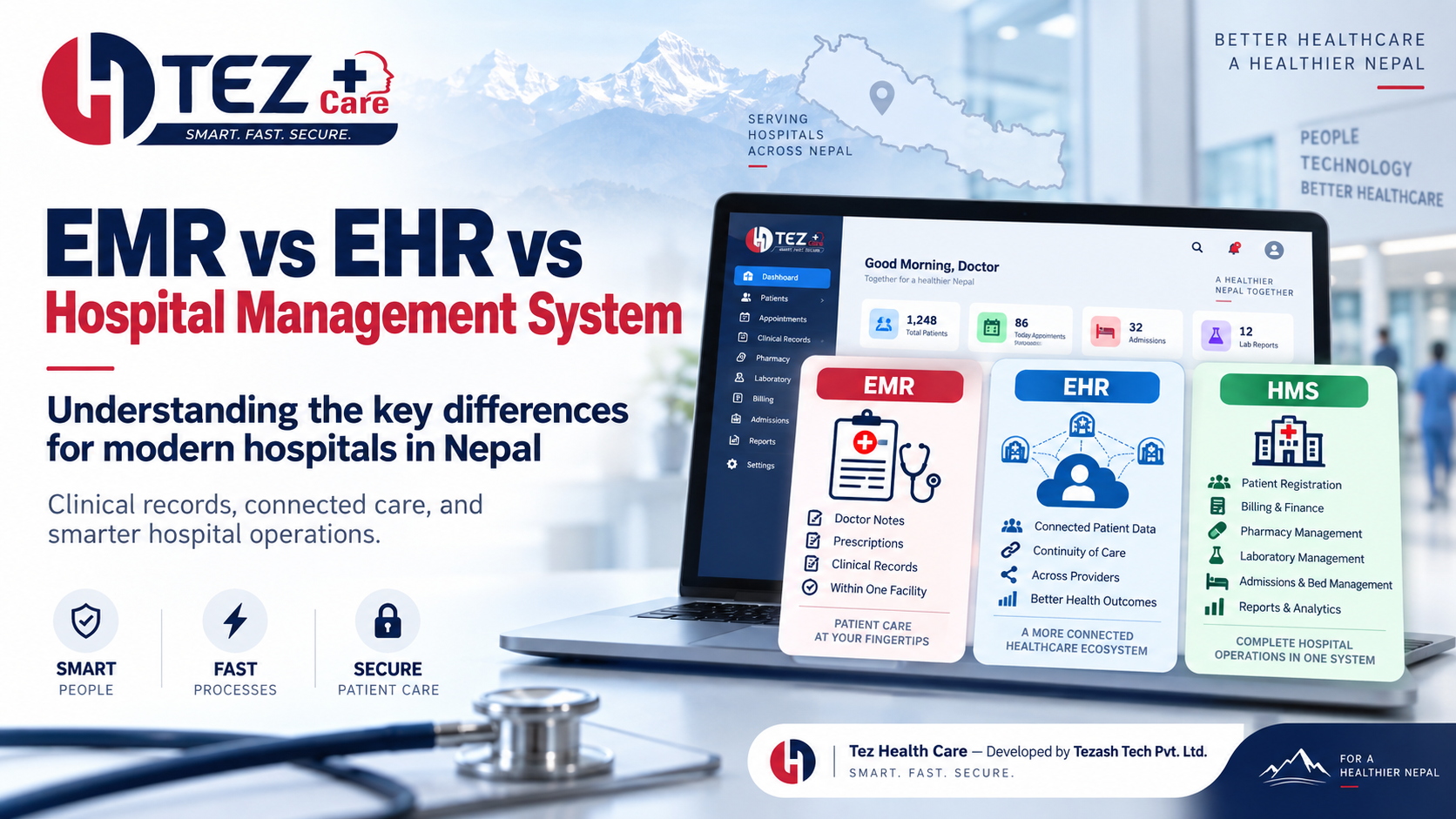
EMR vs EHR vs Hospital Management System | Complete Guide
EMR vs EHR vs Hospital Management System | Complete Guide
Read article
Integrating AI in Our Software: Revolutionizing the Future of Technology
At Tezash Tech, we believe that the future of technology is driven by innovation and intelligence. With the rapid advancement...
Read article